Modern Werk Studio

Carmen Gulliksen · Richmond, Virginia

Working with clients in the US, UK, Germany, Austria and Switzerland

EN|DE

Problem

Your website is not the problem.

What is happening behind it is.

A new coat of paint on a broken process is still a broken process. I rebuild the site and the flow underneath it — around how your business actually works — to a scope, price and date agreed before we start.

See the difference

Live — drag it

Drag this. It is the entire pitch.

Same business, same content, same photographs. Only the structure and the decisions on top of it changed. Most sites I am sent look like the left-hand side.

Musterbetrieb GmbH
[ Bild ]

Herzlich Willkommen auf unserer Homepage!

Wir sind Ihr kompetenter Partner seit 1987. Auf diesen Seiten finden Sie alle Informationen zu unserem Leistungsspektrum.

Bitte nutzen Sie die Navigation am oberen Seitenrand. Bei Fragen erreichen Sie uns telefonisch zu den Geschäftszeiten.

Hier klicken für mehr Informationen >>
ProdukteUnser Sortiment im Überblick ServiceWartung und Reparatur KontaktTel. 0123 / 456 789

Aktuelles: Betriebsferien vom 12.07. bis 26.07. — Wir bitten um Beachtung.

© 2013 Musterbetrieb GmbH · Alle Rechte vorbehalten · Optimiert für 1024x768
Besucher: 24.881

SEIT 1987

Präzision,
die hält.

Wartung, Reparatur und Ersatzteile — bundesweit, mit 24-Stunden-Reaktionszeit.

Termin vereinbarenLeistungen ansehen
ANFRAGE 2026-1184Live
Anfrage eingegangenMo 09:14
Techniker zugewiesenMo 09:31
Termin bestätigtDi 08:00
IM EINSATZ
Reaktionszeit24h
Jahre im Markt38
Techniker17

REFERENZEN

Termin wählen Oktober
Anfrage senden
Bestätigung sofort per E-Mail
Before After
25+ years
Enterprise data architecture, analytics and governance
Scoped
A delivery date agreed in writing before work begins
Fixed
Scope and price agreed before work begins
DE / EN
Delivered in German or English — US, UK and DACH

What it is costing you

Nobody loses a customer because of a font.

They lose them at the point where the website stops and the manual work starts.

The enquiry that died

It arrived in an inbox at 9pm, sat behind forty other emails, and was answered on Thursday. By then they had booked someone else.

The hour you already paid for

Someone on your payroll is retyping names and dates into a spreadsheet that a form could have filled in correctly the first time.

The record nobody can find

Who attended, who paid, who still owes you. The answer exists — spread across an inbox, a calendar and somebody’s memory.

Live — move the sliders

What the spreadsheet actually costs you.

Every booking retyped by hand is time you already paid for. Put your own numbers in.

Every year you spend

78

hours retyping things a form could have captured

That’s10 working days
Worth about$2,730
Time worth6 jobs
Every year, againcompounding
Book a 15-minute call

Solution

Three ways in

Every project is quoted on scope after a short call. No packages, no retainers, nothing you don’t need.

Website refresh

Your site, brought current

  • Existing content and imagery kept
  • Modern, responsive rebuild of the front end
  • Fixed on mobile, where most of your traffic is
  • Contact form that actually reaches you
  • Basic search visibility restored
Book a call

Right when the content is fine and the presentation isn’t.

Most common

Website rebuild

Structure first, then surface

  • Everything in a refresh
  • Information architecture rebuilt from scratch
  • Reordered around what your buyer asks first
  • New visual design, not a template swap
  • Content you can edit yourself afterwards
  • Typically live within two to four weeks
Book a call

The Beitzer engagement, and most of what I do.

Website + system

The half that saves you hours

  • Everything in a rebuild
  • Online registration or booking that feeds a real record
  • Attendance, payment status and participant tracking
  • Automatic confirmations and reminders
  • Reporting you can hand to an auditor or a regulator
  • No more retyping anything
Book a call

When the website was never the expensive problem.

The system

Structure. Rebuild. Connect.

Twenty-five years of enterprise systems work compressed into a process small enough for a small business to afford.

01

Structure

I find out what your business actually does — what a customer is trying to accomplish, what your staff then have to do about it, and where the retyping happens. That map decides everything else.

02

Rebuild

Your existing content and imagery, reorganised and redesigned around that map. Modern, responsive, and editable by you afterwards without calling anyone.

03

Connect

The part most agencies skip: bookings, registrations and payments flowing into something that keeps the record for you, instead of landing in an inbox.

Proof

What this looks like in practice

Four projects, from a forty-year-old German measurement firm to a subscription product with billing built in.

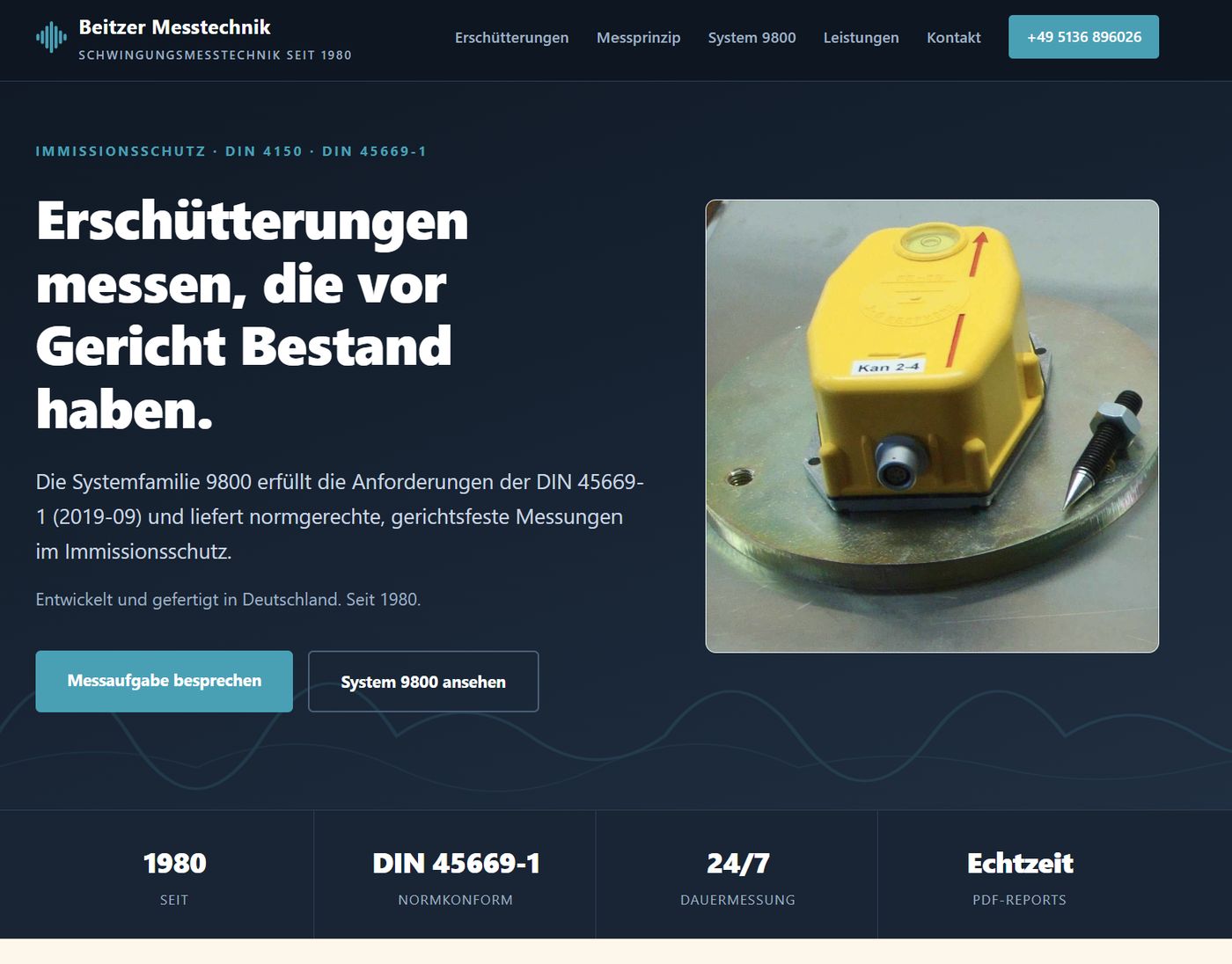
The rebuilt Beitzer Messtechnik website

Beitzer Messtechnik

A forty-year-old measurement business, rebuilt around what it actually sells.

Beitzer builds vibration measurement systems certified to DIN 45669-1. The expertise was never the problem — the site was. Everything a buyer needed already existed, buried in dense technical pages with no order to them.

All content and imagery kept. What changed was the structure: which question a buyer asks first, what answers it, and in what sequence.

Website modernization · German

View the site
HomeLog reporting: 765 hours logged across one school year

HomeLog

A record-keeping product built for people who dread record keeping.

Homeschool records — the reporting families must produce and universally put off. The work went into the entry flow, the data model underneath, and getting a complete year out at the end without the user ever thinking about structure.

Curriculum templates, state requirement checks, time and subject tracking, and reporting you can hand to a district.

Product design · Reporting

View HomeLog
The Readiness Brief showing automatic CE-holder entitlement above a gated issue

Momba Promotions

A subscription publication with the billing and the access rules built in.

A twice-monthly brief for a safety-training company. Free issues, paid monthly and annual subscriptions, subscriber sign-in, and a growing six-module library that subscribers keep.

The interesting part is the entitlement logic. A free reader, a paying subscriber and someone who completed a CE course all see a different page: the CE graduate gets two years of access automatically, granted by their course record rather than a payment. Three states, resolved on every page load.

This is the same problem most small businesses hit with registration and booking. The content is the easy half. It breaks where money and access meet.

Paywall · Entitlements · Subscription billing

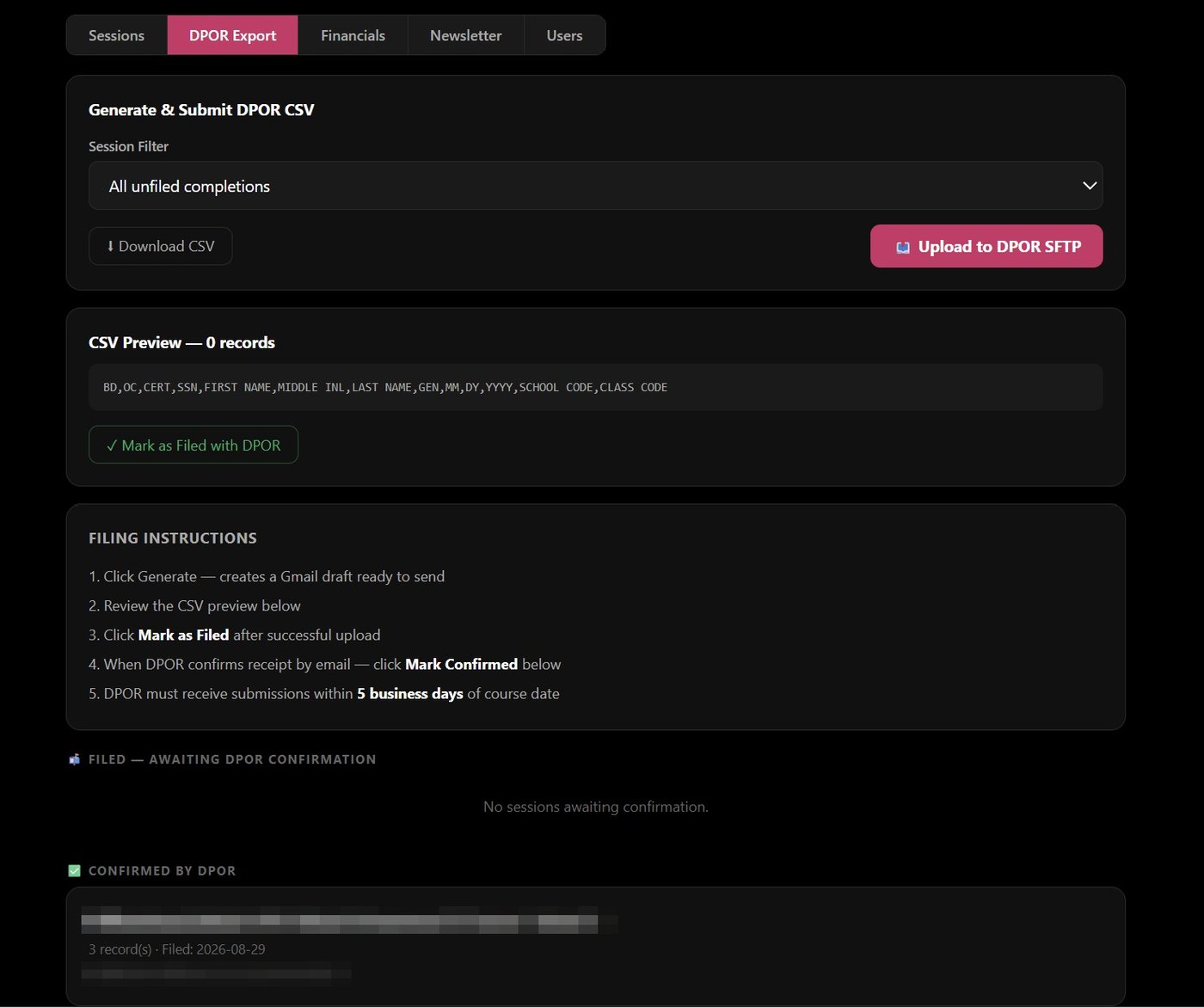
DPOR export screen: CSV generation, filing instructions and a confirmed submission, with client and attendee details redacted

Training business

Six moving parts, one back end, and a regulator on the other side of it.

A training company running six revenue paths at once: course pages and an events calendar, a booking flow that drops a call straight into the calendar, a store with its own fulfillment and refund handling, a membership, a state-approved continuing education course with its own registration path, and a subscription publication.

All six feed one back end that tracks enrollment, attendance and payment.

The hardest requirement was the one nobody sees. This is a state-approved continuing education provider, so every completed course must reach the Virginia regulator in its own CSV format, by SFTP, within five business days of the class. The system builds that file from the attendance record itself, previews it before submission, and tracks each filing from generated to filed to confirmed — instead of someone rebuilding a roster by hand and hoping it lands inside the window.

Regulated reporting is where most small-business systems fall apart. It is also the part a spreadsheet cannot survive.

Regulatory reporting · Registration · Six revenue paths

Client names and addresses redacted.

Objections

The questions everyone has

How fast is this really?

It depends entirely on scope, and I’ll give you a date in writing before we start rather than a slogan. A straightforward site refresh can be live inside a week. A full rebuild is usually two to four weeks. A website with a registration or booking system behind it runs longer — up to about ninety days for the largest, and often well under that. You get the real number on the call, once I know what I’m building.

What do you need from me?

An hour on a call, access to your current site, and answers when I ask about how your business runs. I take the content from your existing site, so there is no writing homework unless you want to change it.

Do I lose my domain or my email?

No. Your domain stays registered where it is and your email keeps working. Only the website moves, and you keep ownership of everything.

What does it cost?

It depends on scope, which is why the call comes first. You get a fixed price in writing before anything starts, and it does not move unless you change what you asked for.

I’m on Wix, IONOS or something similar. Does that matter?

Only in that those builders lock your site inside them and there is no clean way to export it. That is an argument for rebuilding rather than against it — and you end up owning what you paid for.

Can we do this in German?

Yes, end to end. Native German and English — briefings, the build, the copy and the handover, in whichever you prefer.

Tell me about your project.

Fifteen minutes. Tell me what your business runs on now and what isn’t working. I’ll tell you what I’d do about it, how long it takes, and what it costs — on the call, not three weeks later.

Book a 15-minute call

Based in Richmond, Virginia. Working remotely with English- and German-speaking businesses worldwide.